
The legal framework for self-generated, self-consumed rooftop solar has changed significantly since late 2024. Below is a summary of the documents businesses need to know before investing.
Key regulations
- Electricity Law No. 61/2024/QH15: defines self-generated, self-consumed power as electricity produced and consumed at the place of use, mainly to serve the needs of that organisation or individual.
- Decree 58/2025/ND-CP (3 March 2025): detailed regulations on renewable energy development, replacing Decree 135/2024/ND-CP. It sets out the notification and registration procedures for rooftop solar and the mechanism for selling surplus power.
- Decree 243/2026/ND-CP (26 June 2026): amends Decrees 57/2025 and 58/2025. Surplus power may be sold by agreement, up to 50% of generation (previously 20%); the purchase price for surplus power is the average market energy price of the preceding year. The decree also clarifies the use of zero-export devices and widens eligibility for the direct power purchase agreement (DPPA) mechanism.
- Decision 2892/QD-BCT (31 October 2026, effective 1 November 2026): the current retail electricity tariff; the average price is VND 2,159.9/kWh (down 2%), and residential tariffs move to 5 tiers. This is the basis for calculating savings and ESCO unit prices.
- Decision 963/QD-BCT (22 April 2026): new time-of-use periods for production and business customers from 1 November 2026: peak hours 17:30–22:30 Monday to Saturday (no peak hours on Sunday), off-peak hours 00:00–06:00. Because peak hours have moved to the evening, solar mainly replaces normal-hour electricity; to reduce peak-hour costs you need to add battery storage.
- Decree 133/2026/ND-CP (effective 25 May 2026): administrative penalties in the electricity sector; violations of rooftop solar rules can be fined up to VND 100 million.
What it means for businesses
- Systems should be designed to use most of the power on site; any surplus may be sold by agreement within the regulatory limits.
- The notification or registration procedure and fire-safety documents must be completed before operation.
- Under the ESCO model, Viet Green Solar handles all legal procedures for the business.
This article is a summary for reference, updated to November 2026. Please check the original documents or contact us before making an investment decision.
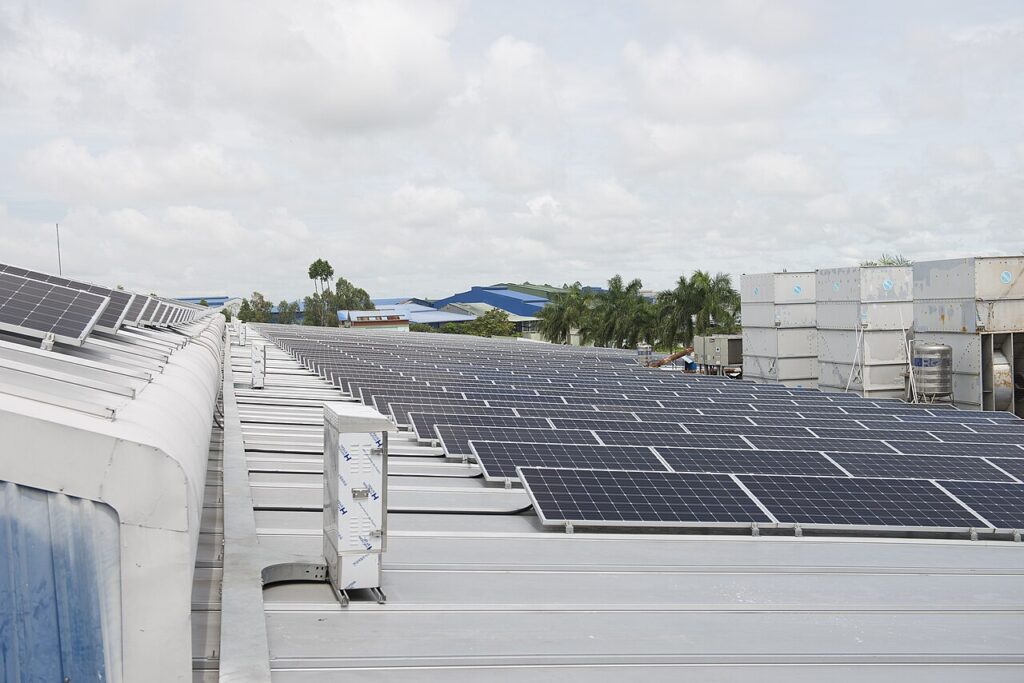
Header image: rooftop solar in Vietnam – USAID Vietnam / Wikimedia Commons (public domain, illustrative).
Want a similar system? Call 0936 388 012 for a free site survey.
Call now